
Formula and inputs
Vₒc = Vset × (1 + Rₛ/Rset), or Vₒc = Vset for High-Z
Vload = Vₒc / (1 + Rₛ/Rload), or Vload = Vₒc for an ideal open circuit
The calculation reconstructs the open-circuit amplitude from the displayed amplitude convention, then applies a resistive divider. The high-impedance option is an ideal open circuit; enter the real resistance, such as 1 MΩ, for a finite load. Amplitude and source resistance may be zero; finite load resistances must be positive.
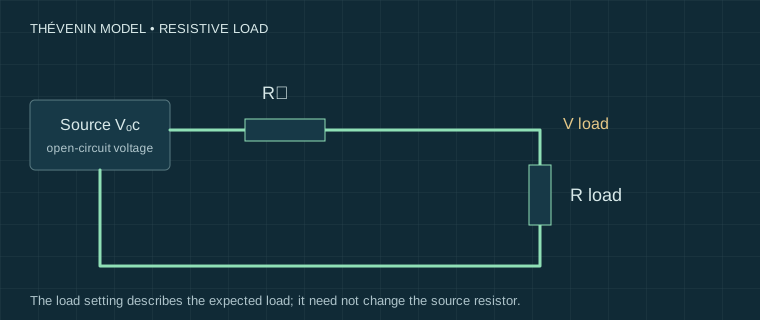
Worked example
With a 50 Ω source set to 1 Vpp into 50 Ω: a 50 Ω actual load receives 1 Vpp; a 1 MΩ load receives about 1.9999 Vpp; an ideal open circuit receives 2 Vpp. With a 1 Vpp High-Z setting and an actual 50 Ω load, the result is 0.5 Vpp.
What the model leaves out
The physical source impedance need not change when the load menu changes. This model excludes clipping, current limits, offset constraints, cable reflections and frequency-dependent impedance. A high-impedance scope input also has capacitance. Confirm the exact generator manual and permitted output before connecting.
Sources and their limits
These references support the principles described here. External tests remain the original authors’ work. Check the exact model manual before connecting equipment.
- Tektronix — Why is the measured AFG/AWG amplitude double the setting? ↗Manufacturer FAQ 57426: a 50 Ω source, matched-load voltage and higher-impedance loads. Our calculator generalises the stated resistive divider; verify the load-setting convention in your model manual.
- Teledyne LeCroy — Oscilloscopes: 50 ohm input and 1 Mohm input ↗Manufacturer explanation of termination and input arrangements; consult the exact instrument manual for limits.
- Teledyne LeCroy — Is it OK to use an external 50 ohm termination? ↗Termination bandwidth and power limitations; not permission to terminate an arbitrary circuit in 50 ohms.
Reviewed for this edition on 22 September 2026. How we use evidence →