
THE DIRECT ANSWER
Choose the instrument around the measurement, connection environment and evidence you need to keep. Portability can matter more than channel count in one task; simultaneous channels, reliable triggering and raw export can dominate another. Neither form factor alone establishes isolation or measurement quality.
Compare the task, not the enclosure
| Requirement | What to verify on either format |
|---|---|
| Learning | Clear controls, accessible trigger states, probe compensation output and an understandable manual |
| Electronics repair | Required input range, low-frequency behaviour, noise, safe reference path and practical probe access |
| Embedded debugging | Simultaneous channels, actual sample rate, depth, trigger/decode capability and useful raw export |
| Portable work | Battery duration, charging restrictions, visibility, storage and documented input isolation |
Bench instruments often offer more controls and channels, but this is not a guarantee for every model. A handheld display may be adequate for a slow signal yet make timing comparisons awkward. Check the actual interface and saved data, not just the screen resolution.
Ask for the manual and an example export
Confirm which specifications apply with all required channels enabled. Check whether the exported file contains the whole record or only displayed points, whether time and voltage scaling are included, and whether you can retrieve it without proprietary cloud access. A screenshot is useful context but is not equivalent to raw samples.
For intermittent faults, inspect single-shot behaviour and available trigger types. Verify whether serial decoding or memory expansion is included, optional or unsupported. A headline waveform-update figure cannot substitute for a trigger capable of selecting your event.
Battery power is not an isolation specification
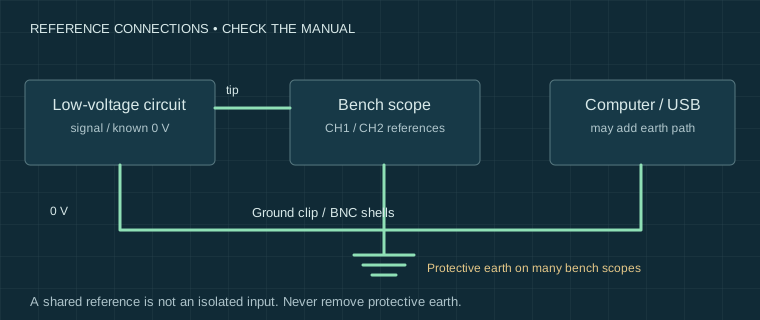
A handheld instrument can share channel references internally. A charger or USB connection can add an earth path that was absent on battery power. Read the limits for the exact operating arrangement; do not infer mains suitability or isolated channels from portability.
Before a low-voltage comparison, draw the scope, circuit supply, computer and generator reference connections. Then check the grounding guide. Automotive use requires its own suitability assessment and accessories.
A practical evaluation without a fake ranking
Use the same low-voltage source to try an edge trigger, a single capture and an export. Log channel count, rate and memory in the selected mode. Repeat a loading-sensitive signal with the intended probe. Record what each arrangement can establish, and what needs a better reference.
ScopeBench has not bench-tested a RIGOL, FNIRSI, Hantek or other model for this launch. Association with retail sites does not validate a product title or specification. There are no model scores or purchasing links here. Next compare the compromises of combination instruments.
Sources and their limits
These references support the principles described here. External tests remain the original authors’ work. Check the exact model manual before connecting equipment.
- Tektronix — XYZs of Oscilloscopes primer ↗Manufacturer primer: acquisition, triggering, probes and measurement systems; not a test of our instruments.
- Elliott Sound Products — Oscilloscopes ↗Independent practical discussion of scope operation and measurement limitations.
- Meettechniek — Oscilloscope probes ↗Independent explanation and experiments on probe loading and compensation; the author’s equipment and conditions apply.
Reviewed for this edition on 22 September 2026. How we use evidence →
Keep a record of the conditions.
Settings, circuit state and limitations belong with the reading. Our templates contain field headers only.
Measurement records & blank templates →